


The FRS 102 changes effective for accounting periods beginning on or after 1 January 2026 introduce important updates to lease accounting and revenue recognition for UK businesses. Under the revised rules, most leases must appear on the balance sheet, while revenue recognition follows a new five-step model based on customer contracts.
These changes may affect reported profits, assets, liabilities and financial ratios, particularly for small and medium-sized companies. Understanding the requirements will help businesses prepare accurate financial statements and assess the impact on their financial performance.
1. FRS 102 Changes to Lease Accounting in 2026
From 1 January 2026, businesses applying FRS 102 must generally recognise most leases on their balance sheets, rather than recording operating lease payments solely as rental expenses.
Under the revised Section 20, companies leasing offices, warehouses, vehicles or equipment will normally recognise a right-of-use asset and a corresponding lease liability.
The new approach brings FRS 102 closer to IFRS 16, providing greater transparency over lease commitments. Although lease payments remain unchanged, their accounting treatment may significantly affect financial statements.
What changes under the new lease accounting rules?
Previously, operating lease payments were generally recognised as expenses in the profit and loss account.
Under the revised standard, lessees must normally:
- Recognise a right-of-use asset: Representing the right to use the leased property or equipment.
- Recognise a lease liability: Reflecting the present value of outstanding lease payments.
- Record depreciation and interest: Replacing the previous operating lease expense with depreciation of the asset and interest on the liability.
These changes may increase reported assets, liabilities and EBITDA while affecting financial ratios used by lenders and investors.
Certain qualifying short-term and low-value leases are exempt from the new recognition requirements.
Practical example: A UK company leasing an office
Consider a UK company entering into a five-year office lease with annual payments of £24,000.
Under the previous operating lease approach, the company would generally recognise £24,000 annually as a rental expense. Under the new approach, the company must calculate the present value of its future lease payments.
Assume:
- Annual rent: £24,000
- Lease duration: Five years
- Discount rate: 5% annually
- Payment timing: At the end of each year
- Other adjustments: No initial costs, incentives or restoration obligations
The discount rate reflects the time value of money. In practice, a company uses the interest rate implicit in the lease where readily determinable, or otherwise its incremental borrowing rate.

How is the lease liability calculated?
The company discounts each annual £24,000 payment to its value at the start of the lease.
PRESENT VALUE CALCULATION
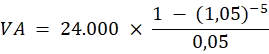
£24,000 × 4.32948 = £103,907.44 – this is the initial lease liability
The calculation can also be understood by discounting the five payments individually.
| Payment | Future Rent | Presnent value |
| Anno 1 | £24.000 | £22.857 |
| Anno 2 | £24.000 | £21.769 |
| Anno 3 | £24.000 | £20.732 |
| Anno 4 | £24.000 | £19.745 |
| Anno 5 | £24.000 | £18.805 |
| Total | £120.000 | £103.907 |
Illustrative figures rounded to the nearest pound. The total uses unrounded values.
The company initially recognises a lease liability of approximately £103,907 and, under these simplified assumptions, a right-of-use asset of the same value.
During the first year, the accounting treatment would be:
- Interest expense: Approximately £5,195, calculated as 5% of the opening lease liability.
- Depreciation expense: Approximately £20,781 annually, assuming straight-line depreciation over five years.
- Lease liability reduction: Approximately £18,805 after accounting for the first £24,000 payment and accrued interest.
Therefore, the first year’s combined depreciation and interest expense would be approximately £25,977, compared with the previous annual rental expense of £24,000.
The FRS 102 changes do not alter the company’s £24,000 cash payment. They change how the lease affects reported profits and the balance sheet.
For further information, consult HMRC’s guidance on the initial measurement of right-of-use assets and lease liabilities.
These changes also influence financial statement presentation. Read WellTax’s article on profit and loss account changes for UK small companies for additional context.

2. FRS 102 Changes to Revenue Recognition in 2026
The revised Section 23 introduces a five-step revenue recognition model based on contracts with customers.
Under the FRS 102 changes, businesses must recognise revenue when, or as, they satisfy their obligations by transferring control of goods or services to customers.
The approach is particularly relevant to companies providing subscriptions, software, construction services or contracts combining multiple products and services. Revenue recognition may change even when the total contract value and payment arrangements remain the same.
Understanding the five-step revenue recognition model
The revised requirements introduce the following process:
- Identify the contract: Establish the agreement with the customer.
- Identify performance obligations: Determine the distinct goods or services promised.
- Determine the transaction price: Calculate the consideration expected.
- Allocate the transaction price: Allocate the price between separate performance obligations.
- Recognise revenue: Record revenue when, or as, the obligations are satisfied.
This model brings UK accounting closer to IFRS 15, with proportionate simplifications for companies applying FRS 102.
Practical example: Software and support services
Consider a UK software company selling a £12,000 package that includes a software licence and 12 months of technical support.
Assume the licence is a distinct obligation satisfied when delivered, and that the relative standalone selling prices support an allocation of £9,000 to the licence and £3,000 to support.
Under the revised model:
- £9,000 is recognised when the licence obligation is satisfied.
- £3,000 is recognised over the 12-month support period.
- £250 per month is recognised as support revenue if services are provided evenly.
This means the company cannot automatically recognise the full £12,000 as revenue when the customer pays.
The timing depends on when each performance obligation is satisfied.
Actual treatment will depend on the contract, particularly whether the customer receives a distinct software licence or ongoing access to a hosted service.
For additional guidance, the Financial Reporting Council’s FRS 102 factsheets explain the revised revenue recognition requirements.

3. How do the two accounting changes compare?
| Area | Approccio precedente | Nuovo approccio dal 2026 |
| Operating leases | Rental expense | Right-of-use asset and lease liability |
| Lease costs | Operating lease expense | Depreciation and interest |
| Revenue recognition | Previous Section 23 criteria | Five-step contractual model |
| Multiple services | Previous revenue allocation requirements | Assessment of distinct performance obligations |
| Financial reporting | Existing accounting policies | Updated calculations and disclosures |
Both changes may affect the timing and presentation of reported income and expenses without altering the underlying contractual cash flows.
4. Frequently Asked Questions About FRS 102
When do the FRS 102 changes take effect?
The principal amendments apply to accounting periods beginning on or after 1 January 2026.
For a business with a 31 December year-end, the first mandatory reporting period will normally end on 31 December 2026.
Do the changes apply to small UK companies?
Yes. Small companies applying FRS 102 Section 1A must generally follow the revised recognition and measurement requirements, although certain disclosure exemptions may apply.
Micro-entities applying FRS 105 follow a different accounting framework.
Will the changes increase Corporation Tax?
Not necessarily. Accounting treatment and taxable profits are not always identical.
Businesses should assess relevant tax adjustments rather than assuming that changes in reported accounting profits will directly increase their Corporation Tax liability.
Do businesses need to restate previous accounts?
Lease accounting requires a modified retrospective transition approach, with no restatement of comparatives.
For revenue recognition, businesses may choose between full retrospective and modified retrospective application, subject to the standard’s requirements.

5. How Should UK Businesses Prepare?
Businesses should review their existing accounting arrangements to understand how the new requirements affect financial reporting.
Three priorities are:
- Review lease contracts: Identify lease terms, payments, discount rates and available exemptions.
- Assess customer agreements: Check performance obligations and revenue recognition policies.
- Update financial reporting: Consider transition adjustments, accounting disclosures and potential effects on financial ratios.
The FRS 102 changes may also influence financial forecasts, borrowing arrangements and management reporting.
WellTax supports UK businesses with accounting and financial reporting requirements, including the preparation of annual accounts.
Understanding the accounting changes early can help companies prepare accurate financial statements, identify necessary adjustments and meet their reporting obligations.
Written by Fabrizia Beux, Senior Associate, ICAEW and Italian Chartered Accountant, WellTax.